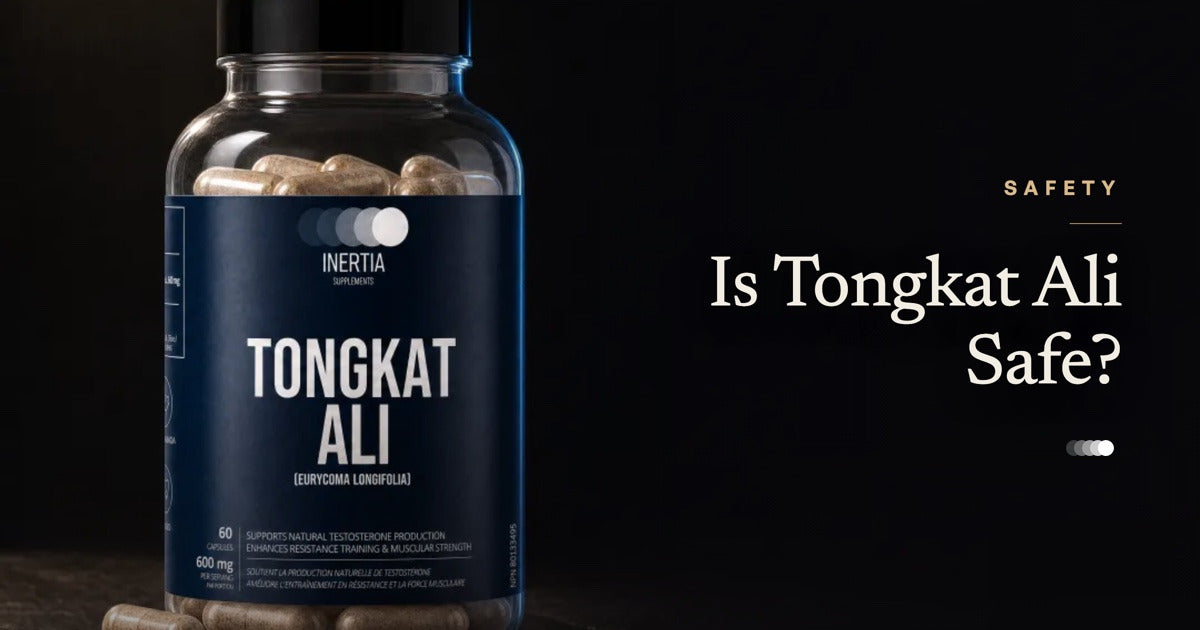
Tongkat Ali (Eurycoma longifolia) is generally described as well tolerated in healthy adults at the studied doses over four to twelve weeks, with sleep disruption the most commonly reported issue. Its Health Canada licence (NPN 80133495) lists cautions and contraindications, and a 2021 EFSA opinion on one extract left a genotoxicity question open, so read both before you start.
This article is educational. The information below covers what the published research and Health Canada’s licence say about Eurycoma longifolia. It is not medical advice. If you have a health condition, take medications, or are pregnant or nursing, talk to your healthcare provider before starting any supplement.
The honest safety picture
Eurycoma longifolia has been consumed as a traditional root preparation in Southeast Asia for generations. The modern research literature, which includes human clinical trials at doses comparable to common supplement doses, generally describes the plant as well-tolerated in healthy adults at sensible doses over the studied trial periods.
That does not mean “take as much as you want with no consideration.” Like any biologically active compound, there are things worth knowing before you start.
The sections below cover the most common concerns honestly.
The sleep question
This is the most frequently reported user experience concern: some people find that Tongkat Ali affects their sleep, particularly at higher doses or when taken later in the day.
The mechanism is not definitively established in the literature, but the pattern is consistent enough in user reports to be worth noting. If you are sensitive to stimulating compounds generally, or if you find your sleep disrupted in the first week or two, try taking it earlier in the day and see if that resolves it.
A few things to be clear about:
- The reported sleep effect tends to be associated with higher doses and evening timing.
- Most users who report it find that taking it in the morning reduces or eliminates the issue.
- It is not universal. Many people taking Tongkat Ali at the studied dose ranges report no sleep disruption.
- Our product is 600 mg per capsule, once daily. Starting at that dose and monitoring sleep quality is a reasonable approach.
If sleep disruption persists beyond two weeks on morning dosing, that is information worth discussing with a healthcare provider.
Reported side effects in the research literature
Clinical trials examining Eurycoma longifolia at doses in the common supplement range (200 to 600 mg of extract per day) have generally found low rates of adverse effects. The most commonly noted in user reports and some studies include:
- Restlessness or a mild stimulant-like effect, particularly at higher doses
- Sleep disruption at evening dosing or higher doses (covered above)
- Occasional mild digestive discomfort in the first week, which often settles
These are not universal, and the published trial data at sensible doses does not characterize them as severe or common. They are things to watch for, especially in the first two to four weeks.
At doses significantly above the studied range, the risk of side effects increases. Staying at or below the dose on the label, at the frequency stated, is the straightforward way to manage this.
The EFSA question
Some buyers who research Tongkat Ali online come across a 2021 European Food Safety Authority (EFSA) opinion that raised concerns about genotoxicity (DNA damage potential) based on certain in vitro and animal studies.
This is worth addressing directly.
The EFSA opinion reviewed a set of studies and concluded that genotoxicity concerns could not be ruled out based on that data. The key details:
- EFSA’s opinion assessed one specific standardized water extract submitted for approval as a novel food at up to 200 mg/day in the EU, a decision about that application, not a finding about every Tongkat Ali extract or the plant in general.
- EFSA’s concern rested on a positive in vitro chromosomal aberration test and a positive in vivo (animal) comet assay, in which the extract caused DNA damage at the highest dose tested (2,000 mg/kg body weight) in tissues at the first site of contact (stomach and duodenum). On that basis EFSA concluded the extract “has the potential to induce DNA damage, which is of concern,” and that its safety “has not been established under any condition of use” for that novel-food application. We are not going to soften what they said.
- The wider genotoxicity literature is mixed: other standardized Tongkat Ali extracts have gone through subchronic toxicity and genotoxicity testing without showing genotoxic effects. Different extracts, doses, and test models give different results, which is part of why the evidence is not settled.
- The human clinical trials on Eurycoma longifolia were designed to measure tolerability and effect, not genotoxicity endpoints, so they neither confirm nor refute the EFSA finding directly. It is more accurate to say the human genotoxicity question is unresolved than to say human studies ruled it out.
- Health Canada reviewed Eurycoma longifolia and granted NPN 80133495 (our product), which remains active; its process considers safety data and it reached a different regulatory outcome than EFSA did for a different product and use. That is a meaningful data point, but it is a regulatory status, not a clean bill of genotoxic safety, and we present it as such.
The EFSA concern is a legitimate data point. It came from a high-dose animal result and an in vitro test on a specific extract submitted for a specific use, not a finding of harm in humans at typical supplement doses. We mention it in full because ducking it would not serve you, and because it is a real reason to respect the dose on the label rather than mega-dose.
This section describes a regulatory body’s assessment of the plant. It is not medical advice and not a statement about this product; if genotoxicity is a concern for you, read the EFSA opinion directly and speak to your healthcare provider before use.
If you want to read the full EFSA opinion, it is publicly available at the European Food Safety Authority website. If the genotoxicity question is a significant concern for you personally, that is a conversation to have with your healthcare provider.
Who should talk to a clinician first
Health Canada’s licence for NPN 80133495 includes cautions and contraindications. We reproduce the key ones here verbatim from the licence:
Consult a healthcare practitioner before use if you:
- Have a weakened immune system or take hypoglycemic agents
- Suffer from any psychological disorder or condition such as frequent anxiety or depression
- Have been diagnosed with hypoactive sexual disorder, sexual dysfunction, or erectile dysfunction
- Have benign prostate hypertrophy or a history of prostate cancer
- Are taking propranolol
- Are taking medications for diabetes, high blood pressure, or seizures
Do not use if you:
- Have prostate cancer, diabetes mellitus, or heart, kidney, or liver disease
- Have a known allergy or hypersensitivity to Eurycoma longifolia or members of the Simaroubaceae family
- Are taking health products that affect blood coagulation, as this may increase the risk of spontaneous bleeding
Stop use and consult a healthcare practitioner if you experience:
- Insomnia, anxiety, or headaches
- Light-headedness, dizziness, blurred vision, or nausea
These cautions are on the Health Canada licence. They are there because they reflect the safety data that the licensing review considered. We include them in full here, not to alarm, but because complete information is more useful than partial information.
What a sensible starting approach looks like
- One capsule (600 mg) per day, in the morning
- With a full glass of water, taken with or without food
- Consistently, daily, for at least four to eight weeks before evaluating
- Not taken alongside any of the contraindicated medications without first consulting your provider
If you are healthy, not on the medications listed above, and have no relevant contraindicated conditions, Tongkat Ali at the standard dose is considered well-tolerated in the published literature.
FAQ
Is Tongkat Ali safe for daily use?
Clinical trials have used daily dosing for periods of four to twelve weeks without significant adverse events in healthy adults. The cautions above apply regardless of duration. If you have any of the conditions or medication situations listed, talk to your healthcare provider before starting.
Does Tongkat Ali affect sleep?
Some users report a stimulant-like effect that can affect sleep, particularly at higher doses or with evening dosing. Taking it in the morning reduces this for most people. If sleep disruption persists at morning dosing, consult a healthcare provider.
What about the EFSA DNA-damage concerns?
The EFSA 2021 opinion (on a specific standardized water extract submitted as a novel food at up to 200 mg/day) found a positive in vitro chromosomal aberration test and a positive in vivo animal comet assay at a high dose, and concluded the safety of that extract was not established for that use. Other standardized extracts have tested negative for genotoxicity, and the human trials measured tolerability and effect rather than genotoxicity endpoints, so the question is genuinely unresolved rather than closed in either direction. Health Canada reached a different regulatory outcome and the licence for our product (NPN 80133495) remains active. If the genotoxicity question matters to you, read the EFSA opinion and discuss it with your clinician.
Is it safe to take long-term?
Long-term human safety data beyond twelve weeks is limited. The animal data at very high doses raised genotoxicity concerns (see the EFSA question above); the human trials were not designed to test for that, so long-term genotoxic safety in humans is simply not well characterized. As with most supplements, long-term use is best managed with periodic check-ins with a healthcare provider, particularly if you have any of the conditions listed in the contraindications.
Can women take Tongkat Ali?
The majority of clinical research on Eurycoma longifolia has been conducted in men. Some studies have included women. The Health Canada licence does not restrict use to men (the licensed claims are not gendered on this NPN). If you are pregnant or nursing, do not use. If you have any of the conditions in the contraindications above, consult a healthcare provider.
The cautions and contraindications above are reproduced from Health Canada’s Licensed Natural Health Products Database (NPN 80133495). The educational content in this article is framed as ingredient science on Eurycoma longifolia and should not be read as a claim about what this product will do for you. Talk to your healthcare provider for advice specific to your situation.
What to read next
For the full research picture on Eurycoma longifolia, including what is well-evidenced and what the honest limitations are, read the Tongkat Ali research guide.
For the honest timeline on how long a fair trial takes, read How long does Tongkat Ali take to work?
For a plain-English explanation of the 100:1 ratio and what to check on any label, read What 100:1 actually means on a Tongkat Ali label.