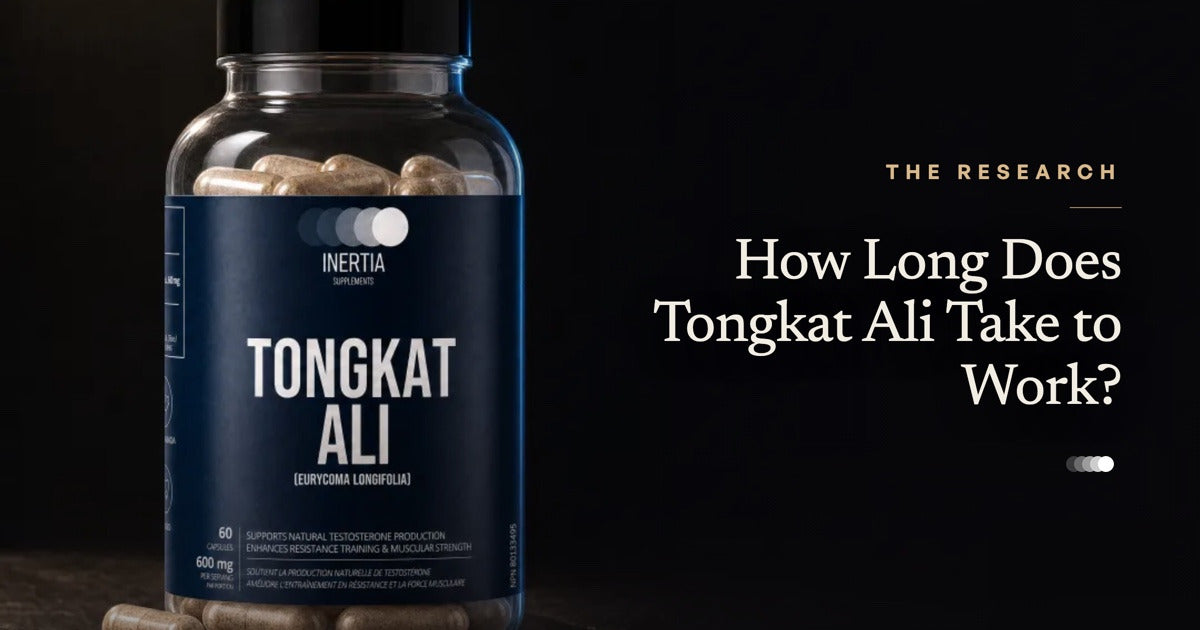
Expect weeks, not days: the published trials on Eurycoma longifolia ran four to twelve weeks, so give Tongkat Ali at least four weeks of consistent daily use and judge it at six to eight. Track one measurable signal, such as a training metric or sleep data, rather than waiting for a day-one feeling.
The question almost nobody answers honestly
Search “how long does Tongkat Ali take to work” and most results will give you a number with no context: two weeks, four weeks, sometimes as little as three days. A few brands will imply you will notice something by the first morning.
The honest answer is: it depends, it takes longer than most people expect, and building consistent expectations upfront makes for a better experience than chasing a promise the first week.
Here is what the research on Eurycoma longifolia examines, what that means in practical terms, and what a fair trial looks like.
Why Tongkat Ali is not a same-day supplement
Eurycoma longifolia is not a stimulant. It does not produce an acute effect the way caffeine or a pre-workout does. The pathways the research examines in this plant operate over time, with consistent daily use. Think of it less like flipping a switch and more like tilting the baseline, gradually, in a direction you can measure after weeks of consistency.
This is not a shortcoming. It is how this category of compounds tends to work.
The clinical studies that examined Eurycoma longifolia used trials of roughly four to twelve weeks. Shorter than four weeks is not enough time to draw conclusions from the literature, and it is probably not enough time for you to draw conclusions from your own experience either.
Consistent use, daily, at a properly specified dose, over at least four to eight weeks is the fair-trial standard the research supports.
“I’m three weeks in and feel nothing. Is it working?”
This is probably the most common question from people who have started Tongkat Ali and are reading everything they can find.
A few things worth considering:
Three weeks is on the short end. Some of the effects the research examines are more visible at eight weeks than at four. If you are looking for something to compare from week one to week eight, three weeks may simply not be enough data.
What you are measuring matters. “Feeling something” is vague. If you are tracking sleep, energy levels across a full week, performance on a training metric, or how you feel during stressful work periods, you have data to compare. If you are waiting for a distinct single sensation, you may not notice gradual improvement until you look back over a longer window.
Dose and form matter. A 600 mg capsule of a 100:1 full-spectrum extract is a specified dose from a specific starting material. The research literature uses studied dose ranges that reflect several weeks of consistent administration. Lower or inconsistent doses extend the time before anything is observable. Knowing what you are taking, at what dose, and from what form of the plant is part of evaluating a fair trial.
Consistency matters more than timing. Some people ask whether morning or evening dosing changes the timeline. The research does not support a strong claim either way, though some users report taking it earlier in the day to avoid any effect on sleep quality (more on this in the safety article). What the research is clear about: daily consistency over weeks matters more than the time of day.
If you are at three weeks with nothing noticeable, the more useful move is to extend the trial to six or eight weeks before drawing a conclusion, rather than changing the product.
What does “working” actually look like?
Part of why expectations get mismanaged is the way Tongkat Ali is marketed. Terms like “boost your T,” “unleash drive,” and “day-one results” set a frame that the actual science does not support.
The research on Eurycoma longifolia examines it in the context of:
- Resistance training performance and muscular strength (one of the three claims licensed under NPN 80133495)
- Hormone markers in men with lower baseline levels, and in older men
- Stress physiology, specifically cortisol response in moderately stressed adults
- Healthy sexual interest (also licensed under NPN 80133495)
None of these are instant-onset effects. They are cumulative outcomes that become measurable over weeks. If you are using Tongkat Ali alongside regular training, the training metric is probably your most reliable feedback signal. If you are tracking HRV or recovery data, look at trends across a month, not day-to-day variance.
The honest shape of a positive response is: gradual, comparative, and most visible when you look back over a period of consistent use rather than checking daily.
What a fair trial looks like
Minimum duration: four weeks. Useful data window: six to eight weeks.
Dose: take the dose on the label, consistently, daily. Our Tongkat Ali is 600 mg per capsule, one capsule per day. Do not split the dose or vary it day to day during the trial.
Single-ingredient advantage: because our product contains one ingredient (Eurycoma longifolia, at a specified dose and ratio, NPN 80133495, third-party lab-tested), you know what you are running the trial on. If you get a result, it is attributable. If you do not, you have eliminated one variable. A proprietary blend does not give you that clarity.
Track something specific. Training output, sleep quality, or a HRV metric gives you a number to compare. Waiting for a general feeling is a harder test to evaluate honestly.
Give it a consistent run before evaluating. If you change the dose, timing, or product partway through, the trial is confounded.
The brands that promise results in three days are setting you up to quit too early. The research suggests the timeline is weeks, not days. We think saying that plainly is more useful than telling you what you want to hear.
FAQ
How long before I notice something?
The research on Eurycoma longifolia uses trial periods of four to twelve weeks. Most studies measuring meaningful outcomes ran for at least four weeks, with clearer effects at eight. That is the honest range. Individual responses vary, and consistency of use matters more than any single variable.
Should I quit if I feel nothing by week two?
Not based on the literature. Two weeks is below the studied timeframes. Extend the trial to at least four to six weeks with consistent daily use before drawing conclusions.
Is it a placebo if I don’t feel it right away?
Not necessarily. Gradual physiological changes can be real without producing a noticeable acute effect early in a trial. The appropriate test is a comparison of a measurable metric (training performance, sleep data, a hormone panel) before and after a full trial, not a search for a day-one sensation.
Does morning or evening dosing change how fast it works?
The research does not establish a strong preference. Some users take it earlier in the day to avoid any effect on sleep. Consistency matters more than timing.
Can I take it every day, or do I need to cycle?
The published trials generally used daily dosing for the study duration. Some users choose to cycle (five days on, two off, for example) based on preference. Our guide on dosage and cycling covers this in more detail.
What to read next
For the full picture of what the research on Eurycoma longifolia examines, read the Tongkat Ali research guide.
For questions about safety, sleep effects, and who should talk to a clinician first, read Is Tongkat Ali safe? Side effects, honestly.
For a plain-English explanation of the 100:1 ratio and what the spec on our label actually means, read What 100:1 actually means on a Tongkat Ali label.